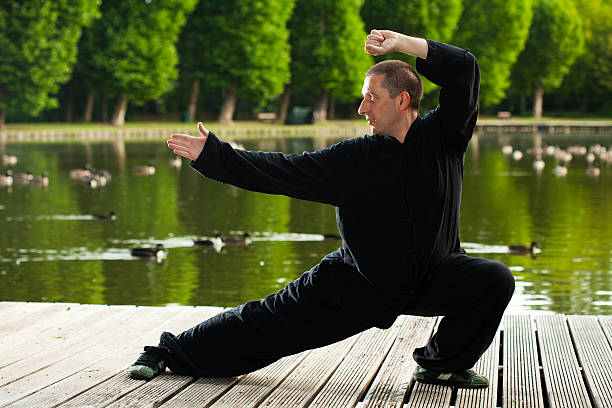
Tai Chi (Taijiquan) is traditionally organized into five family styles, each with its own flavor, movement quality, and training emphasis. While all share the same internal principles—relaxation (song), structure, balance, and mindful flow—their outward expression can feel quite different. Often, people naturally gravitate toward a style that mirrors their personality and preferred way of moving.
The Five Family Styles
Chen Style
The oldest recorded style, Chen alternates between slow, flowing movements and bursts of explosive power (fa jin). Its spiraling “silk-reeling” actions and lower stances may appeal to individuals who enjoy athleticism, dynamic changes in pace, and a strong martial focus.
Yang Style
Known for its large, open, and even-paced movements, Yang style is the most widely practiced worldwide. Its smooth, continuous tempo suits individuals who prefer steady rhythm, expansive posture, and a calming, meditative flow.
Wu (Jianquan) Style
Characterized by compact movements and subtle internal refinement, this style often resonates with those who appreciate precision, sensitivity, and understated strength rather than big external expression.
Wu (Hao) Style
A smaller-frame, highly precise style emphasizing alignment and internal awareness. It may attract detail-oriented individuals who enjoy subtle adjustments and refined control.
Sun Style
Recognizable by its agile, smooth stepping and upright posture, Sun style blends Tai Chi with elements of Xingyi and Bagua. Its light footwork and gentle transitions often appeal to those who prefer mobility, fluidity, and continuous motion without deep stances.
Variations and Modern Forms
In addition to the traditional family styles, there are simplified and standardized variations. One of the most popular is the 24-Form (Simplified Tai Chi), developed in 1956 and largely based on Yang style. It preserves the flowing qualities of Yang style while offering a shorter, more accessible sequence for beginners and group practice.
The 24-Form is widely used in therapeutic and wellness settings. For example, it is incorporated into Quality PT’s practice as a gentle, structured way to improve balance, coordination, posture, and mindful movement.
Although each style has its distinct character, the heart of Tai Chi remains the same: cultivating harmony between body and mind. The “right” style often feels natural—like an extension of how you already move through the world.